






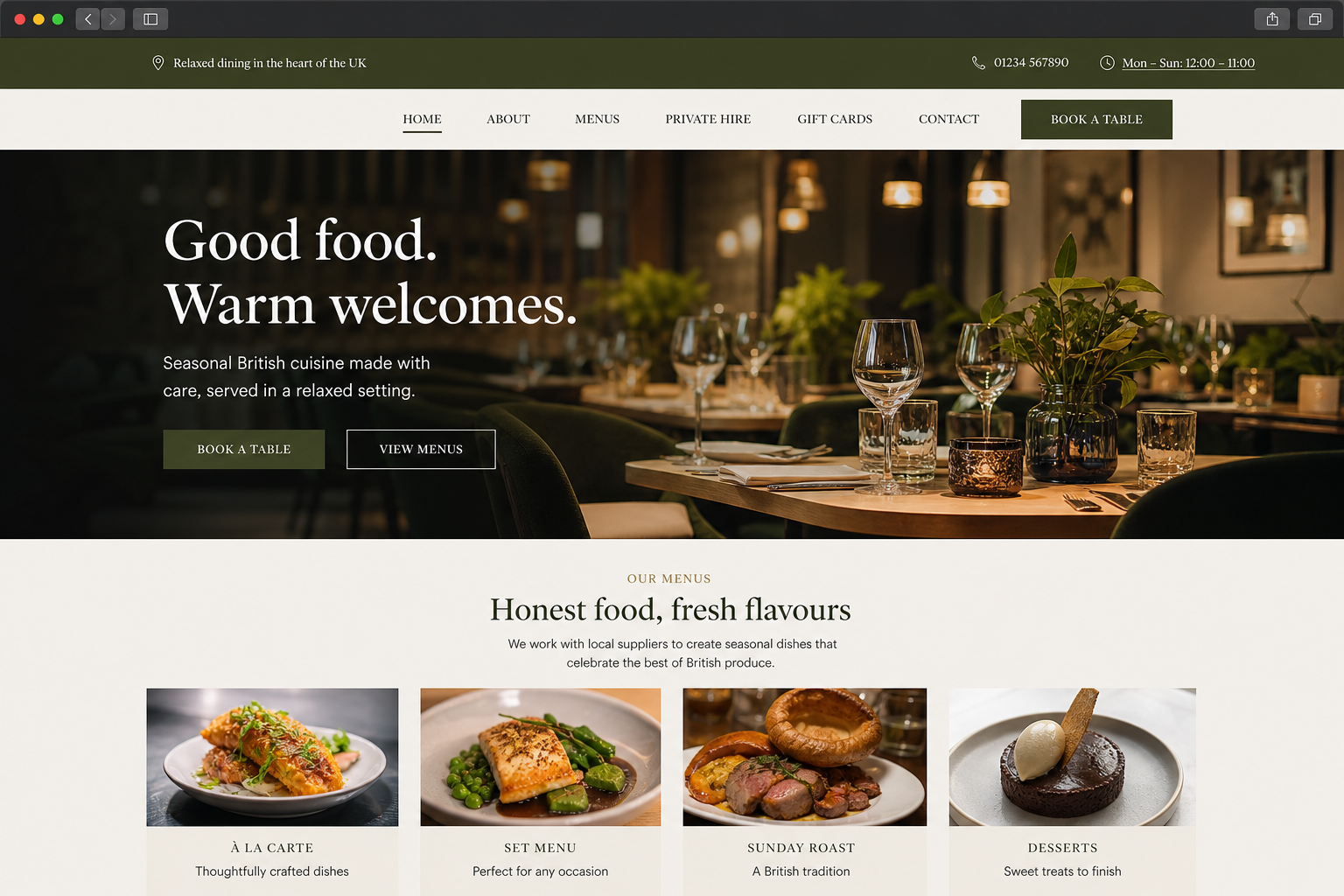








1/11
WordPress design
Custom WordPress builds on a 5-year hosting agreement
Trades & home services — emergency call-out, service grid, local trust signals
View WordPress design
Nano & Micro entry
Apps+OS from £5.33/mo — WordPress eligible
Small — 3 months free
Most popular starter — trial on new accounts
Scale plans
X-Large through 16X-Large for growth clients
Professional mailboxes
Webmail on your domain — monthly and annual plans
Uptime monitoring
External checks and alerts before customers notice
1/11
WordPress design
Custom WordPress builds on a 5-year hosting agreement
Trades & home services — emergency call-out, service grid, local trust signals
View WordPress design





1/8
Custom development
Bespoke sites, apps, and integrations
Ecommerce retail — product discovery, merchandising, and checkout-ready layout
View Custom development
Someone on your team installs antivirus, ticks the firewall box on the server, and assumes the website is now protected. Then the site gets defaced through a vulnerable plugin, and everyone is baffled because the security tools were all green.
The gap is that none of those tools were watching the right thing. The attack came in through the front door of the website itself, dressed as an ordinary request, and that is precisely the job a web application firewall exists to do.
It helps to place a web application firewall, or WAF, against the tools people confuse it with. Antivirus scans files on a machine for known malware. A network firewall decides which ports and addresses can talk to your server at all. Neither one reads the actual content of a web request.
A WAF sits in front of your website and inspects every request before it reaches your application. It understands the language of the web, so it can tell the difference between a normal form submission and one crafted to break in. Cloudflare's explainer on what a WAF is describes it neatly as a shield that filters traffic at the application layer, where the other tools simply do not look.
The reason a WAF is worth having is that a large share of attacks target the application rather than the network. The long running OWASP Top Ten catalogues the most common of these, and a good firewall is tuned to recognise the patterns behind them.
Injection attacks slip malicious commands into an input field, hoping your application passes them straight to the database. A classic example is SQL injection, where a carefully written string in a search box tricks the database into handing over data it should never reveal. A WAF spots the tell tale shapes of these payloads and refuses them before they reach your code.
Cross site scripting, or XSS, smuggles a script into a page so it runs in another visitor's browser, often to steal their session or redirect them. The OWASP description of cross site scripting shows how varied the technique is, and a firewall with current rules catches many of the common variants automatically.
Threats do not stand still, so a static rule set ages quickly. New vulnerabilities are disclosed constantly, each one a fresh recipe attackers can try against unpatched sites within hours of it becoming public.
This is where managed rules earn their keep. Instead of you writing and updating firewall logic by hand, a managed WAF receives regular rule updates from a security team that tracks new disclosures. Open rule sets such as the OWASP Core Rule Set show the principle in action, and commercial offerings build on the same idea with faster turnaround. Our Imunify360 protection takes this approach, pairing managed rules with reputation data so newly weaponised flaws are blocked before you have even read the advisory.
Where the firewall sits changes how much it protects. Run it at the edge, in front of your hosting rather than buried inside the application, and you stop bad requests before they consume any of your server's resources.
Edge filtering has a useful side effect. Because malicious traffic is turned away early, your server spends its capacity on real visitors rather than fending off junk. It also means a single firewall can guard everything behind it, rather than each site reinventing its own defences. The National Cyber Security Centre's small business guide makes the broader case for layering protection like this rather than relying on any one tool.
A WAF is powerful, but it is not a magic shield, and treating it as one is a common mistake. It filters traffic. It does not patch your software, choose strong passwords, or fix a misconfigured permission.
If your content management system is months behind on updates, a determined attacker may still find a route the rules do not cover. If an admin account uses a weak password, no firewall stops someone simply logging in. The WAF is one layer in a stack, and it works best alongside prompt patching, sensible access control and reliable backups.
Think of it as the bouncer on the door rather than the entire security plan. It turns away the obvious trouble and buys you time against the rest, which is genuinely valuable, but the rest still needs doing. We treat it as part of a wider posture, set out on our security overview, rather than a box to tick and forget.
Understood that way, a web application firewall stops being a mysterious acronym and becomes what it really is: the tool that watches the one entrance every visitor, friendly or otherwise, has to come through.

Security
You do not need a security team to protect customer data well. A handful of disciplined habits stops the overwhelming majority of incidents.

Security
Plenty of small sites assume they are too minor to attack. Automated floods do not check your turnover before they knock you offline.

Security
Every site needs the padlock, but the certificate behind it comes in several flavours. Here is which one actually suits your business.



Comments